
Strategy · Field notes
Marketing teams are expected to move faster than ever. Campaigns launch constantly, SEO competition keeps tightening, and website performance now sits squarely on the revenue side of the ledger. Most marketing directors we talk to are quietly negotiating the same trade-off: the ability to update a site quickly without waiting on developers, against the need for a platform that can actually scale.
At the same time, AI-assisted website development has moved from novelty to standard practice. Tools now generate layouts, components, and entire applications from a prompt. But while AI can compress weeks of frontend work into days, it does not automatically solve SEO structure, scalability, governance, or content management.
AI is accelerating how websites get built. Architecture still decides whether they last.
For organizations evaluating a redesign or replatform right now, three approaches are on the table, and the differences matter more than they used to.
1. Traditional CMS platforms
WordPress, Drupal, Sitecore, Umbraco. These systems remain popular because they let marketing teams publish without touching code, update pages, ship blog posts, manage metadata, launch landing pages, wire in forms. WordPress in particular has narrowed the gap with newer visual editors, and for many smaller organizations it is still the fastest way to get a polished marketing site online.
The trouble shows up later, as the site grows. Plugin-heavy stacks get slower. Structured content becomes harder to model. Technical SEO hits a ceiling. Design systems drift. And anything more advanced than a content edit usually ends up back on a developer's desk. For SEO-focused organizations, site speed and Core Web Vitals quietly start to cost money.
2. AI-assisted website builders
A newer category, Lovable, Framer, Base44, v0, Claude-driven workflows, focuses on generating the website itself: layouts, components, styling systems, frontend code, even content drafts. The speed gain is real. Teams can prototype a landing page in an afternoon, spin up a campaign microsite in a day, or A/B test a new section without an engineering ticket.
The misconception is that an AI-generated site is automatically scalable or SEO-ready. In practice, many of them still ship with hardcoded content, thin metadata, inconsistent components, and no real editorial workflow. The frontend got fast; the architecture underneath it did not. Teams often discover that every meaningful update still requires someone who can read the code.
3. Headless CMS + AI-built frontend
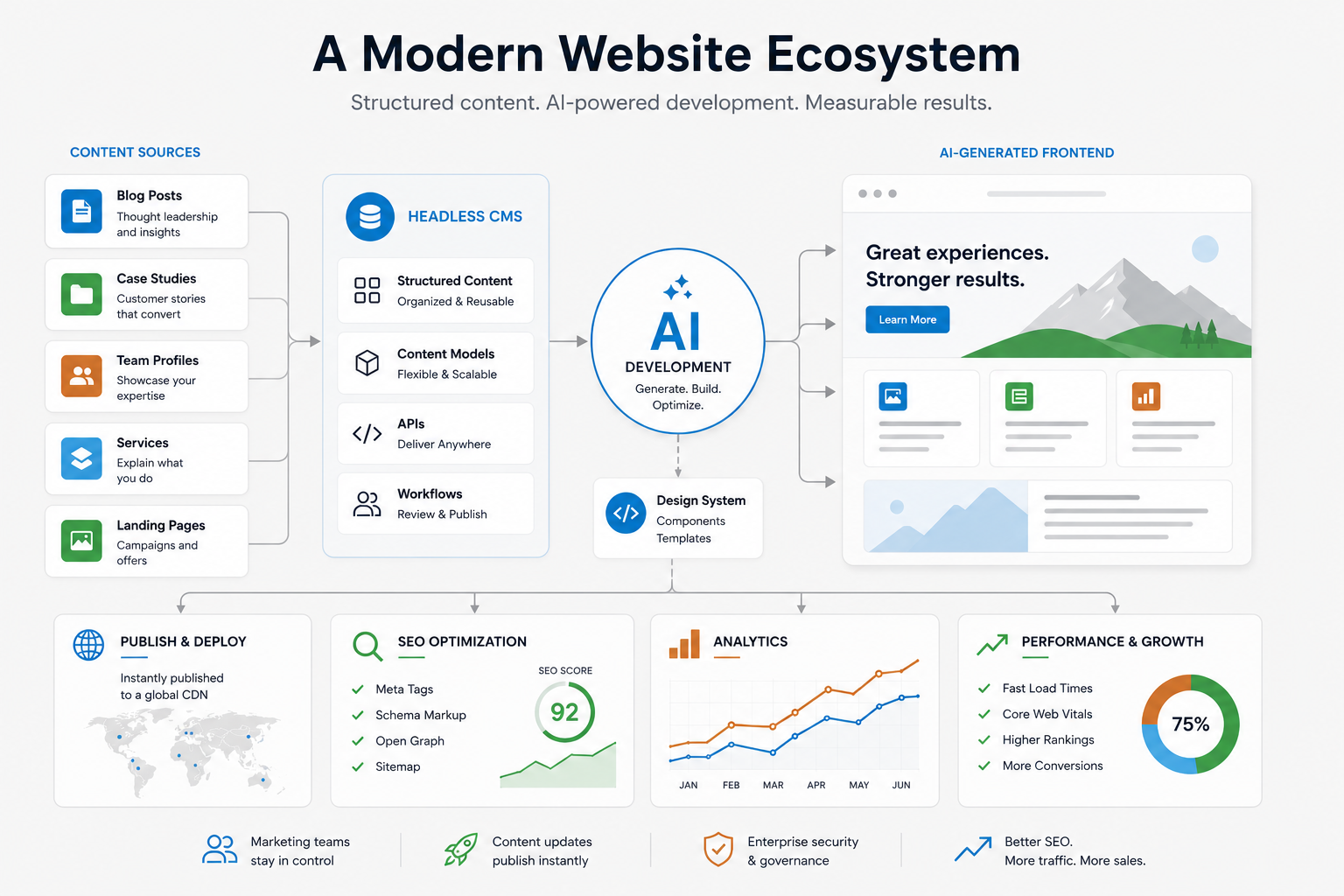
This is where most modern digital teams are heading, and where we increasingly build for our own clients. A headless CMS, Sanity, Contentful, Prismic, separates content from presentation. The CMS stores and serves structured content through APIs; a modern frontend framework renders the site independently. Increasingly, that frontend is accelerated with AI-assisted tooling rather than hand-coded from scratch.
The combination is unusually strong. AI rapidly generates reusable sections, responsive layouts, and interactive components. The headless CMS owns content structure, SEO metadata, blog publishing, case studies, landing page copy, and editorial workflow. Design, content, and SEO infrastructure stop fighting each other.
The SEO and performance case
For organizations where organic growth funds the business, this architecture has measurable advantages. Modern frontend frameworks paired with a headless CMS typically produce faster page loads, better Core Web Vitals, cleaner markup, stronger mobile performance, more flexible metadata control, and far better structured data implementation. Those wins compound into higher rankings, better engagement, and more conversions, performance has stopped being a developer concern and become a revenue one.
Editorial workflow, the quiet advantage
One myth worth retiring: that headless platforms are harder for marketers to use. Modern headless editors are often better than the page-builder experience inside a traditional CMS. Teams can draft, preview, request approvals, reuse structured content across pages, and publish instantly without a redeploy. For organizations with multiple stakeholders, frequent campaigns, and an active SEO program, that workflow is the difference between a site that keeps up with the business and one that constantly lags it.
The trade-off: more upfront planning
The honest downside of the headless + AI model is that it demands more thinking before any code gets written. Content modeling, component systems, SEO architecture, governance, and frontend integration all need real decisions early. It is not plug-and-play. But for most organizations we work with, that upfront discipline is exactly what unlocks the long-term flexibility.
Which path fits which kind of company
Traditional CMS still makes sense for small marketing sites with a single editor, simple content needs, and no ambitious SEO program. It is the right answer more often than the industry likes to admit.
AI-assisted builders are excellent for rapid experimentation, campaign microsites, prototypes, MVPs, internal tools, and anything where speed matters more than longevity.
Headless CMS plus an AI-built frontend is the right answer when SEO drives meaningful revenue, content marketing is central to growth, performance directly impacts conversion, or the team needs to scale publishing without scaling headcount.
The bigger shift
Websites are quietly evolving from static marketing assets into dynamic content systems. The companies pulling ahead are not just "using AI to build websites." They are building structured content ecosystems, faster publishing pipelines, performance-optimized frontends, and scalable marketing infrastructure. AI is the accelerant. Architecture is the asset.
For marketing directors, the goal is no longer launching a website. It is building a digital platform that lets the team publish faster, rank better, convert more reliably, and grow without a constant technical bottleneck.
Frequently asked questions
- Should I use an AI website builder for my company site?
- For a single landing page, a prototype, or a small brochure site, AI builders like Wix AI, Framer AI, and Durable can ship something usable in an afternoon. For anything with real content scale, multiple authors, integrations, or brand requirements, a traditional or headless CMS is still the right answer.
- What is the best CMS for a marketing team in 2026?
- WordPress remains the safest default for content-heavy sites with non-technical authors. For teams that want a modern editor, structured content, and a developer-friendly stack, Sanity, Contentful, and Payload are the leading headless choices. Webflow sits between the two and is strong for design-led marketing sites.
- Are AI website builders SEO-friendly?
- They can be, but they often ship slow, generic markup, weak schema, and limited control over metadata, canonicals, and redirects — exactly the things modern AI search rewards. Plan to outgrow the SEO ceiling of an AI builder within a year or two of meaningful traffic.
- What is a headless CMS plus AI workflow?
- It is the pattern most growing marketing teams are quietly moving to: a headless CMS holds structured content, a custom front end renders it, and AI tools assist with drafting copy, generating variants, translating, and producing imagery. The team keeps brand and SEO control while getting most of the speed AI promises.
- Can AI replace a web design agency?
- AI is replacing the production work — laying out a page, generating placeholder copy, cutting image variants. It does not replace strategy, brand voice, information architecture, or the judgment calls that decide whether a site actually converts. Most agencies, including ours, now use AI heavily inside that judgment. designrush partner
More reading
The ADA Website Deadline Is Coming: What State and Local Agencies Need to Know
The DOJ Title II rule requires state and local government websites to meet WCAG 2.1 Level AA, with deadlines in April 2027 and April 2028. Here is what the rule covers, how to test, and a realistic path to compliance.

Nonprofit Websites That Build Trust & Drive Donations
What separates a nonprofit site that builds donor trust and quietly grows giving from one that drains staff time, plus the fundraising platforms actually worth using right now.